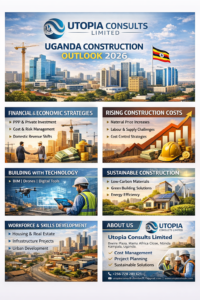

What Construction Leaders in Uganda Must Know for 2026
As we enter 2026, Uganda’s construction industry stands at a crossroads shaped by economic shifts, technology adoption, sustainability imperatives and evolving market demands. For industry leaders — from CEOs and project managers to government planners and developers — understanding these trends is essential to stay competitive, deliver quality projects, and drive long-term growth.
- Economic Realities and Funding Shifts
Economic tightening ahead
Uganda is planning to cut external budget support significantly and pivot toward domestic revenue mobilization in the 2026-27 financial year. External financing from grants and loans is set to fall sharply, placing greater emphasis on local investment and revenue streams for infrastructure development and public projects.
Implication for construction leaders:
- Diversify funding sources — explore private financing, PPPs (public-private partnerships) and local capital markets.
- Align with domestic revenue goals — position projects that support national economic priorities to attract government backing.
- Rising Costs and Inflationary Pressures
Inflation in construction inputs — though moderate recently — points to shifting material and labour cost dynamics in Uganda. Construction Input Price Index data shows modest rises, especially in civil works and finishing components, affecting total project budgets.
Other local reports highlight broader construction cost increases affecting housing and infrastructure.
What leaders should focus on:
- Tight cost control systems and value-engineering early in design.
- Enhanced forecasting models to anticipate price volatility.
- Strategic procurement — bulk purchasing, forward contracts, and local supplier partnerships.
- Embracing Technology and Digital Transformation
Digital tools are no longer optional. Global construction trends see technologies like Building Information Modelling (BIM), drones, and project management software reshaping how projects are planned and executed.
In Uganda, drones are increasingly used for topographic surveys and monitoring, while BIM adoption helps improve coordination and reduce errors.
Actionable steps for leaders:
- Invest in tech training for staff — digital skills boost efficiency, safety, and accuracy.
- Pilot BIM and drone workflows on larger projects to demonstrate value.
- Integrate systems (design, scheduling, cost control) to enable data-driven decisions.
- Sustainability and Low-Carbon Construction
Globally, construction is under pressure to reduce emissions — partly due to heavy CO₂ output from materials like cement. Emerging markets may struggle to decarbonize quickly, but sustainability is increasingly a competitive differentiator.
Local advocates and demonstration projects — like affordable earthen floor innovations — highlight low-carbon alternatives suited to Uganda’s context, with social and environmental benefits.
Strategies for leaders:
- Adopt greener materials and methods where feasible.
- Educate clients on life-cycle cost savings of sustainable buildings.
- Track regulatory developments — especially as international investors and lenders increasingly require sustainability metrics.
- Skills Shortages and Labour Challenges
Uganda’s construction workforce faces a shortage of formally trained professionals, which can slow projects and impact quality.
For 2026, leaders must:
- Invest in workforce development — in-house training, apprenticeships and partnerships with technical institutions.
- Improve labor planning — better scheduling, incentives, and retention strategies.
- Leverage technology to bridge skills gaps, such as digital training tools and productivity software.
- Market Opportunities: Infrastructure and Urban Growth
Uganda’s construction sector continues to expand, with growth in housing, commercial real estate, and infrastructure — including significant projects like the JLOS House development and new public amenities.
Events like the Uganda Buildcon International Expo 2026 and industry trade shows are focal points for new business, networking, and exposure to global innovations.
Leaders should:
- Engage with industry expos and networks to find partners and innovations.
- Target niche markets such as mixed-use developments and urban regeneration.
- Position projects that align with government infrastructure plans and urbanization trends.
- The Rise of Modular and Off-Site Construction
Modular and prefabricated building techniques are gaining traction globally for their cost, quality, and timeline advantages.
In Uganda, this means:
- Exploring pre-fabricated components for housing and commercial projects.
- Partnering with manufacturers to reduce on-site labour demands.
- Leveraging modular techniques to respond to affordable housing needs.
Conclusion: A Strategic Focus for 2026
For construction leaders in Uganda, 2026 is a year of adaptation — balancing economic constraints, technological evolution, sustainability pressures, and workforce challenges. Success will come to those who embrace innovation, strengthen cost and project management, develop local capacity, and position their businesses to serve emerging market demands.